
You and a friend type exactly the same query into Google, sitting next to each other — and see different results. Sound familiar? It’s one of the most frequently repeated beliefs about the internet: that Google “knows” who you are and shows everyone a different reality tailored to them. The truth is more complicated — and, as it turns out, it’s the subject of a real dispute between Google itself and its competitors.
In this article, I break search personalization down into its components: where the “filter bubble” myth came from, what Google officially says about its own personalization mechanisms, what the high-profile 2018 dispute with DuckDuckGo looked like, and — since it’s worth understanding from the technical side too — how a search engine’s infrastructure, at the engineering level, accounts for differences that we mistakenly attribute to personalization.
Where the “filter bubble” myth came from
The term filter bubble was brought into common use by American activist and entrepreneur Eli Pariser in his 2011 book “The Filter Bubble: What the Internet Is Hiding from You,” and he popularized it the same year in a famous TED talk. In it, Pariser described an anecdote that became the starting point of the entire debate: he asked two acquaintances — with a similar social profile and education — to search for “BP” during the oil spill from the Deepwater Horizon platform in the Gulf of Mexico. One saw mainly investment results about the company BP, the other — results about the environmental disaster.
Pariser’s thesis was this: algorithms that personalize content (not only on Google, but also on Facebook) gradually lock users into information “bubbles,” showing them more and more of what already confirms their views and less and less of what could confront them with a different point of view.
It’s an important and influential theory — but, as you’ll see later in the article, its empirical confirmation is much weaker than its popularity suggests.
A dispute over the facts: DuckDuckGo vs. Google (2018)
The most concrete test of this theory, still cited today, is a study conducted in June 2018 by DuckDuckGo — a search engine competing with Google that builds its brand on not tracking users. 87 participants in the US simultaneously searched for the same three terms — “gun control,” “immigration,” and “vaccinations” — both in incognito mode and in a regular, logged-in browser window.
DuckDuckGo presented the results as proof that the filter bubble exists: most participants saw sets of results unique to them, and the differences persisted even in incognito mode and after logging out — from 57% (for “immigration”) to as many as 92% (for “vaccinations”) of participants saw personalized results even in private mode. DuckDuckGo recorded the biggest differences in the news and video blocks.
Google responded to these results directly and publicly. Danny Sullivan, Google’s official Search Liaison, wrote a series of messages in which he called the idea of strong personalization a “myth.” According to Sullivan, differences in results for the same query usually stem from causes unrelated to personalization: location, language settings, platform, and — what’s especially important from a technical point of view — the dynamic, distributed nature of the search system itself. Sullivan also stated plainly: “We don’t personalize search results based on demographic profiles, nor do we create such profiles for use in Google Search.”

What Google officially says about personalization
According to the official Google Search Help documentation, true personalization based on your account and activity history is in practice limited to a few specific situations:
- Ambiguous queries — if you search for an entity with an unclear name (the classic example Google gives is “apple” — the fruit or the tech company), your earlier search history related to that term may affect the order of the results.
- Order, not content — personalization most often changes the order of already-selected results, not the set of results itself. Sometimes it also changes the order of content blocks — if you usually watch videos, videos may appear higher than web pages.
- Recommendation features — what’s personalized is primarily features like Discover, “what to watch” recommendations, or event suggestions — not the core search results.
- The news carousel is never personalized — this is one of the few places where Google explicitly declares that personalization has zero effect.
You’ll find control over this mechanism in the “Web & App Activity” and “Personalized Recommendations” settings in your Google account — you can turn them off at any time, although turning them off doesn’t delete the history already saved (that has to be done separately).
How much truth there is in it — an academic perspective
This is where it gets interesting: even though the concept of the filter bubble is extremely popular in public debate (it’s sometimes cited as one of the explanations for Brexit or political polarization in the US), reviews of the scientific literature indicate that the empirical evidence for it is much weaker than you might think. According to an analysis published in Internet Policy Review, empirical research on filter bubbles and the related phenomenon of “echo chambers” generally doesn’t confirm the strong version of this thesis — users of search engines and social media usually have access to fairly diverse, centrist content, often more diverse than people who don’t use these tools.
That doesn’t mean personalization doesn’t exist — rather, it shows that reality is more nuanced than the popular slogan suggests: differences in results are real and common, but their main source is less often a sophisticated psychological profile of the user and more often much more mundane technical factors.
Through an engineer’s eyes: why a search engine by its nature can’t give everyone identical results
This section looks at the problem from the side of the search system’s architecture — exactly as an engineer working on search engine infrastructure would explain it.
1. A search engine isn’t one database, but thousands of distributed copies. Google’s index — the database of all known web pages — is too large to keep in one place. It is replicated across many data centers around the world, and each of them updates with its own delay. When your query goes to a data center in Warsaw and your friend’s query goes to one in Frankfurt, you may get slightly different results simply because one data center received the latest index update a few minutes earlier than the other. Google explicitly cited this phenomenon as one of the main, non-personalized causes of differences in its response to the DuckDuckGo study.
2. Ranking is the result of dozens of independent systems, not a single algorithm. What we colloquially call “the Google algorithm” is actually a set of many specialized ranking systems (query understanding, page quality assessment, spam detection systems, local systems, result “freshness” systems) operating in layers. New versions of these systems are deployed gradually, often via a staged rollout to a selected percentage of traffic — which is why two people may get different versions of the ranking for the same query, even though neither of them is “personalized” in the sense of a user profile.
3. Query context is always processed — even without an account. The IP address (and thus approximate location), the browser’s language header, the type of device, and the time of day are signals processed for every query, logged in or not. From a technical point of view, this isn’t “personalization” in the sense of a behavioral profile — it’s contextualizing the query, which is necessary for the result to be useful at all (otherwise every “pizza near me” query would return the same restaurants to everyone in the world).
4. True behavioral personalization is a separate, much smaller layer. The search history signal is attached at the very end of the query processing pipeline — usually as an additional factor in re-ranking an already finished list of results, not as an input to the main content selection system. Architecturally, this explains why the influence of account history is, according to Google’s statements, limited mainly to the order rather than the set of results.
How to check for yourself what affects your results
Instead of assuming that a difference in results is automatically a “filter bubble,” it’s worth approaching it methodically — just as with verifying any other information online.
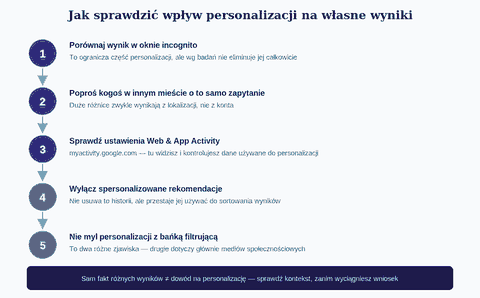
Step 1: Compare the result in an incognito window
This is a good first test, although — as the DuckDuckGo study showed — it doesn’t completely eliminate personalization, because context (location, language, device) is processed anyway.
Step 2: Ask someone in another city to do the same query
If the differences are large, in many cases it’s location, not your account, that accounts for most of the discrepancy — especially with local or news queries.
Step 3: Check your Web & App Activity settings
At myactivity.google.com, you can see exactly what data is collected and used for personalization, and turn off individual categories.
Step 4: Turn off personalized recommendations
This doesn’t delete saved history, but it stops using it to sort future results — a good way to separate the effect of personalization from the effect of context.
Step 5: Don’t confuse search personalization with the social media filter bubble
These are two different, though often confused, phenomena. Content recommendation algorithms on social media (the feed, “for you”) work on completely different principles and have a much stronger documented influence on what you see than classic Google search.
Frequently asked questions
Will two people searching for the same term always see identical results?
No, and that’s normal. Location, language, device, time of day, and the update status of individual data centers are enough to generate differences — without any account-based personalization.
Does logging out of your Google account guarantee “neutral” results?
Not quite. The DuckDuckGo study showed that differences persist even in incognito mode and after logging out — because context (location, device) is still processed regardless of account status.
Does the existence of differences in results confirm the filter bubble theory?
Not necessarily. Differences in results are a documented fact, but reviews of academic research indicate that the strong version of the filter bubble thesis — the gradual, systematic isolation of the user from differing views — has much weaker empirical support than its popularity in public debate suggests.
Summary
Different results for the same query are a fact, but the cause is rarely as dramatic as the popular “filter bubble” myth suggests. The real picture, confirmed both by Google’s official position and by reviews of academic research, is more mundane: what comes into play is the architecture of a distributed search system, the query context (location, language, device), and only at the end — relatively limited account-based personalization. Understanding this difference isn’t just a technical curiosity — it’s a concrete tool that lets you judge more accurately whether what you see in search results says more about the world or just about your latest clicks.
Want to dig deeper into the topic?
If you like the way we write about searching for and verifying information, here’s how you can go a step further:
- 📘 Get our guide — a complete guide to effective searching and evaluating information: buy the “How to Search?” guide
- 💛 Support the blog’s development on Suppi — every bit of support helps us create more materials like this: support us on Suppi
- 🎥 Visit our YouTube channel — there we explain the same topics in video form: see our YouTube