
Same news, different headlines — how do you compare several newsrooms’ coverage of the same topic? When something important happens in Poland — a Sejm decision, a protest, a court ruling — within an hour, a dozen or so accounts of the same event appear online. The problem is that after reading three different news sites, you may feel as if you’ve read about three different events. This isn’t an accident or the result of journalists’ incompetence (just as with the psychology of clickbait headlines). It’s the effect of a mechanism that communication scholars call framing — and one you can recognize if you know what to look for.
In this article, I’ll show what it means for different newsrooms to frame the same event, what mechanisms lie behind it, what it looks like in practice on the Polish media market (based on real academic and industry research), and how to compare several accounts step by step so you can separate fact from interpretation yourself.
Why different newsrooms write “differently” about the same event
In communication studies, this phenomenon is described by two complementary theories.
Agenda-setting theory, formulated in 1972 by Maxwell McCombs and Donald Shaw at the University of North Carolina, says that the media don’t so much tell people what to think as decide what they will think about at all — by choosing which topics make the headlines and which are left out. In their classic study of the 1968 US presidential election, the authors showed a strong correlation between the topics that dominated the media and the topics voters considered most important.
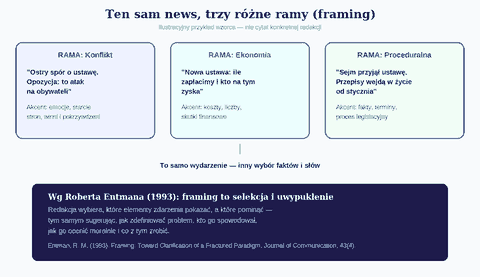
Framing theory, in the version formulated by Robert Entman in 1993 in his now-classic article “Framing: Toward Clarification of a Fractured Paradigm”, goes a step further. According to Entman, framing consists of selection and salience: a newsroom selects certain aspects of an event and makes them more prominent in the text in such a way as to suggest a particular problem definition, cause, moral evaluation, and recommended solution. In other words — it’s not what the newsroom says outright, but what it considers important enough to put in the headline at all, and what it pushes to the end of the text or leaves out completely.
What this looks like on the Polish market — three documented examples
Example 1: a study of TVP Info and TVN24 “tickers” (London School of Economics, 2017)
One of the most precise comparative studies of Polish news media is an analysis conducted by researcher Rafał Zaborowski, associated with the London School of Economics and King’s College London. The team analyzed more than 8,700 so-called “tickers” — short text messages displayed on air — from 24 hours of TVP Info and TVN24 broadcasting on November 11, 2017, that is, during the events surrounding the celebrations of National Independence Day.
The events both stations covered were exactly the same — the same marches, the same politicians’ statements, the same course of the day. The study’s author showed, however, that the way these events were described — the choice of words, the tone, the emotional coloring of the tickers — differed so systematically that the media began calling this style at TVP Info “tickers of fear” or “tickers of terror.” It’s a good example of how the difference doesn’t have to concern the facts as such (both stations covered the same events), but the way they are wrapped linguistically — that is, framing.
Example 2: an analysis of the main TV stations’ news programs (Towarzystwo Dziennikarskie, 2020)
Towarzystwo Dziennikarskie (the Journalists’ Society) — an organization that regularly monitors the quality of Polish news media — analyzed the three main TV news programs over one week (January 13–19, 2020): TVP’s “Wiadomości,” Polsat’s “Wydarzenia,” and TVN’s “Fakty.” The conclusion of this analysis is especially relevant to the topic of this article: the selection of information — that is, which topics made it on air at all — didn’t differ significantly between the stations. What differed was the way the same topics were presented and the opinions expressed (directly or indirectly) when presenting them.
This distinction is key: agenda-setting (what to show) and framing (how to show it) are two separate mechanisms, and this study clearly shows that the newsrooms differed mainly in the second dimension, not the first.
Example 3: how Poles assess media impartiality (CBOS)
A CBOS survey showed that more than half of Poles surveyed (56%) believe most TV stations aren’t impartial in presenting information — a 5 percentage point drop in trust compared with the 2017 survey. Importantly, CBOS also showed that the choice of station from which Poles get their news is strongly correlated with political views: viewers who identify with the right more often choose TVP1 and TVP Info, left-leaning viewers — TVN and TVN24, and people with centrist views — Polsat and “Wydarzenia.”
This phenomenon, known in media research as selective exposure, closes a vicious circle: people choose sources consistent with their own views, which in turn reinforces the perceived credibility of those sources and distrust of the others.
These data correspond with the international Reuters Institute Digital News Report 2025 (University of Oxford), according to which trust in the media in Poland rose to 47% in 2025 (an increase of 8 percentage points over the previous year), although it still varies depending on the specific broadcaster and is strongly linked to political polarization.
What a difference in framing looks like in practice — an illustrative example
The example below is illustrative — it shows a typical pattern of differences in framing the same fictitious event (the passage of a new law), not a literal quote from any specific newsroom. The point is to illustrate the mechanism described by Entman, not to judge specific publications.
| Frame | Typical emphasis of the headline | What is usually highlighted | What is usually left out or moved lower |
|---|---|---|---|
| Conflict | A dispute, a clash, one side’s outrage | Emotions, critics’ statements | The substantive details of the regulation itself |
| Economic | Costs, who will gain and who will lose | Numbers, amounts, forecasts | The political context of the decision |
| Procedural | The fact of passage, the dates of entry into force | Chronology, the formal process | Controversies and voices of opposition |
Step by step: how to compare several newsrooms’ coverage yourself
The method below is based on the principle of source triangulation — a technique known from qualitative research methodology that involves comparing independent sources of information about the same phenomenon in order to distinguish common elements (probably factual) from divergent elements (probably interpretive).

Step 1: collect at least three sources with different profiles
One public source (e.g., the public broadcaster), one commercial, and one independent or foreign. The more varied the sample, the easier it is to see which elements of the coverage are common to all (probably facts) and which appear only in some versions (probably interpretation).
Step 2: compare the headline and lead separately from the body
The headline and the first paragraph (the lead) are where the newsroom makes the most important decisions about what to consider the heart of the event. It’s worth noting what made it into the headline of each account and what appeared only later in the text — it’s a direct indicator of the hierarchy of importance adopted by a given newsroom.
Step 3: mark what’s missing from each version
This is the most often overlooked step in verifying information yourself. Leaving out a certain fact, context, or side of a conflict is just as significant a form of framing as word choice — Entman explicitly calls it part of the “selection” mechanism. Placing several accounts side by side lets you notice which elements are missing from all of them, and take into account the selection made by each newsroom.
Step 4: check which sources each text relies on
Does the article cite specific names, documents, and figures — or rather anonymous “sources close to the matter”? Texts based on verifiable sources are generally more credible than those that rely mainly on unspecified opinions.
Step 5: build your own, composite picture of the situation
The last step is synthesis: treat as facts what is repeated in all independent accounts, and as interpretation what appears selectively, only in some of them. This way of reading the media doesn’t eliminate the need to have your own opinion, but it lets you base it on broader material than one randomly chosen account.
Why it matters — the consequences of living in a single-source bubble
As the CBOS survey cited earlier showed, the choice of news source in Poland is strongly linked to political views, and using only one broadcaster that matches your own views intensifies polarization. The 2025 Reuters Institute report also notes that in the countries of Central and Eastern Europe — including Poland — growing distrust of traditional media fosters the spread of disinformation, especially through social media, where framing mechanisms are even less transparent than in traditional newsrooms.
The habit of comparing several independent accounts of the same event is one of the most effective, and at the same time simplest, methods of limiting the impact of this phenomenon on your own perception of reality.
Frequently asked questions
Does this mean one of the newsrooms is “lying”?
Not necessarily. Framing usually doesn’t involve giving false information, but rather selectively choosing true facts and words that together create a particular picture of an event. That’s why recognizing framing is harder than detecting ordinary disinformation — it requires comparison, not just checking a single fact.
Are public media more biased than commercial media?
The studies cited (LSE, Towarzystwo Dziennikarskie) point to clear differences in presentation between the public broadcaster and commercial stations in the periods studied, but the framing mechanism — with varying intensity and in different directions — applies to practically all newsrooms, regardless of the ownership model.
How many sources do you need to compare to be sure?
There’s no magic number, but communication researchers recommend the principle of diversity in source profiles over sheer number — three varied sources (public, commercial, independent/foreign) usually give more than ten sources with a similar profile.
Summary
Differences in headlines and in the way different newsrooms report the same event aren’t accidental or solely the result of bias — it’s a scientifically documented mechanism of framing, described as early as 1993 by Robert Entman and confirmed in research on the Polish media market, from the analysis of TVP Info and TVN24 “tickers” to the monitoring by Towarzystwo Dziennikarskie. Understanding this mechanism and consciously comparing several independent accounts of the same event is one of the most important skills of critical media consumption — it lets you separate what actually happened from how a newsroom decided to tell the story.