
Content farms and link farming are one of the most serious quality problems in search today — this guide shows how to recognize them.
Content factories that are flooding the internet — and destroying your trust
Content farms are flooding the internet with worthless content today, and link farming artificially boosts its rankings in Google. In April 2025, 74% of newly published web pages contained AI-generated content — and a year earlier, Google itself admitted outright that its search engine was being flooded with content created on an industrial scale. The phenomenon isn’t new, but it has never before operated on such a scale, and it has never before been so hard to tell it apart from real, valuable sources.
When we talk about the quality of the internet, we usually think about disinformation or the errors of artificial intelligence. Less often do we talk about something more mundane, yet just as harmful: a mechanism that for years has been systematically lowering the quality of what we see in search results. Content farms produce articles not to help anyone, but just to exist in Google’s index. Link farming does the same with links — it builds artificial authority where there is no real knowledge or experience. The effect is the same: it’s becoming harder and harder to find something online written by a person with real knowledge rather than by a process optimized for the algorithm.
01What are content farms and link farming?
A content farm is a website whose main goal isn’t value for the reader, but generating as many pages indexed by search engines for as many phrases as possible. The business model is simple: the more pages, the more visits from search engines, the more ad impressions or clicks on affiliate links. Quality is a secondary variable here — scale is what counts.
A classic example is the American company Demand Media and its website eHow — at their peak, they published thousands of short, poorly verified articles a day, written en masse by low-paid freelancers for predetermined, popular search phrases. In February 2011, Google responded with an algorithm update known as Panda, aimed directly at content farms — it affected as much as 11.8% of all queries in the US, more than any previous update. Demand Media later reported a loss of 6.4 million dollars in one quarter, partly because of Panda.
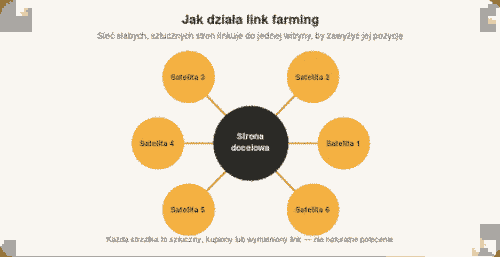
Link farming is the equivalent of the same phenomenon on the link side, not the content side. Instead of mass-producing articles, networks of websites are created whose only purpose is to link to each other or to one target website — artificially inflating its authority in the eyes of the algorithm. The best-known form is PBNs (private blog networks) — sets of seemingly independent sites, often based on expired domains with a history, actually controlled by a single owner solely to build links.
The scale of the phenomenon in numbers
02How content farms and link farming work in practice
The mechanics are usually similar: the target page receives links from dozens or hundreds of weak, loosely related websites — bought, exchanged, or created specifically for this purpose. A common variant is triangular link exchange (site A links to B, B to C, C to A), which is meant to hide the direct relationship between the sites from the algorithm. Another is using expiring domains with an established history and real authority, which are taken over and filled with new, unrelated content solely to exploit their old reputation.
A newer, more sophisticated variant is so-called keyword swarming — a practice described in 2024 by HouseFresh, a small, independent reviewer of air purifiers. According to an account by a former employee of the large publisher Dotdash Meredith, the company deliberately “swarmed,” publishing a dozen or so articles on a topic in which the independent site ranked high — in order to overwhelm it with numbers and push it down the results. HouseFresh lost most of its search traffic this way.
A third phenomenon, increasingly penalized by Google, is site reputation abuse , also colloquially called “parasite SEO” — publishing weak, commercial content on a subdomain or in a section of a large, trusted brand to take advantage of its authority. A high-profile example is Forbes Advisor, which, according to industry estimates, earned about 236 million dollars a year from this kind of content before Google tightened its policy on the matter in 2024.
03Case gallery: how content farms and link farming flooded the web
These aren’t single, isolated incidents. Below are examples, documented and repeatedly confirmed in independent sources, of how content farms and link farming have really affected the quality of search results — from 2011 to the present day.
Demand Media / eHow and the Panda update
Google Penguin hits PBNs
Dotdash Meredith vs. HouseFresh
Forbes Advisor and “parasite” SEO
74% of new pages contain AI content
17.6% of new pages entirely AI-generated
Scaled Content Abuse — a new spam policy
Bots have overtaken humans in web traffic
04Why content farms destroy trust in the internet
The consequences of content farms and link farming go far beyond rankings in Google. When search results fill up with content optimized for the algorithm rather than the reader, independent creators lose — smaller, specialized websites run by people with real knowledge, like HouseFresh, which physically tested equipment instead of paraphrasing product descriptions from Amazon. Increasingly, it’s precisely such voices that disappear from the results, pushed out by entities with bigger budgets for content production at scale, not greater subject-matter knowledge.
This phenomenon fuels the discussion around the so-called dead internet theory — the claim that an ever-larger share of online activity is generated not by people, but by bots and automated systems. Not long ago it was treated as an internet curiosity. Today, with 51% of web traffic coming from automation and more than a third of new pages created with the help of AI, it’s increasingly hard to dismiss it as pure conspiracy theory — Stanford researchers estimated that we are already about 17% of the way toward a scenario in which the web is dominated by content not created by humans.
Who loses when scale wins
The problem also has a practical dimension for the reader: since it’s increasingly hard to tell content written by an expert from content mass-generated for keywords, the risk grows that we make decisions — about purchases, health, finances — based on material that no one has ever verified in practice.
05How Google responds to content farms and link farming
For fifteen years, Google has been waging something like an arms race with content farms and link farming — every major algorithm update forced new, more sophisticated ways of getting around the rules, which the next update then responded to.
None of these updates solved the problem permanently — each one limited one tactic, after which another appeared, adapted to the new rules. That’s why responsibility can’t rest solely with the algorithm. A reader who knows how to recognize a content farm is a much harder target than one who trusts every result on the first page.
06Checklist: how to recognize content farms and link farming
 Before you judge a website, check these six signals.
site:to check what else the domain publishes07Frequently asked questions about content farms
How are content farms different from link farming?
Is every website that publishes a lot of content a content farm?
Has Google fully solved the content farm problem?
How can I quickly check a domain with the operator site:?
site:?site:domainname.comto see all the indexed pages of a given domain — it helps you judge whether it publishes coherent, topical content or hundreds of unrelated articles.Where can I learn more about verifying sources?
See the full list of sources (25+)
Content farms: history and Google updates
- Search Engine Land, Google forecloses on content farms with “Farmer” algorithm update — searchengineland.com
- Search Engine Land, A Complete Guide to the Google Panda Update — searchenginejournal.com
- Seeking Alpha, Google’s Panda Update Likely to Negatively Impact Demand Media — seekingalpha.com
- Search Engine Land, Private blog networks: A great way to get your site penalized — searchengineland.com
- Amsive, Google’s Helpful Content Update & Ranking System — amsive.com
- Google Search Central, What web creators should know about our March 2024 core update and new spam policies — developers.google.com
Site reputation abuse and keyword swarming
- HouseFresh, HouseFresh disappeared from Google Search results. Now what? — housefresh.com
- Search Engine Land, Small review site lost 91% of its Google traffic to affiliate-focused SEO content — searchengineland.com
- uSERP, Google Cracks Down On Parasite SEO In Site Reputation Abuse Policy Update — userp.io
- Cory Doctorow (Pluralistic), Keyword swarming and site reputation abuse — doctorow.medium.com
The scale of AI content and bot traffic
- Ahrefs, What Percentage of New Content Is AI-Generated? — ahrefs.com
- Gizmodo, Dead Internet Theory Is 17% of the Way to Becoming Reality, Study Finds — gizmodo.com
- Fast Company, ‘Dead internet’ theory coming true? New Stanford research — fastcompany.com
- Imperva, 2025 Imperva Bad Bot Report: How AI is Supercharging the Bot Threat — imperva.com
Want to be able to tell a reliable source from a content farm?
💛 Buy us a coffee on Suppi
One-time support with no commission for the creator — it helps us create more educational materials.
Support on Suppi▶️ Watch on YouTube
Practical examples of searching for and verifying information in video form — subscribe so you don’t miss the next episodes.
YouTube channel